
Iran's Islamic Revolutionary Guard Corps (IRGC) claims control of the Strait of Hormuz and reports striking a US destroyer, escalating tensions in the Middle East following retaliatory strikes between Iran, the US, and Israel.

A US Air Force officer was rescued from deep inside Iran after his jet was shot down, following a two-day mission involving US Special Operations forces. The officer evaded Iranian forces for over 24 hours, hiding in a mountain crevice and hiking to high altitudes before being rescued.

Two expatriate workers were killed after debris from a downed drone fell in an industrial area in the Sohar province of Oman.

Secretary of State Marco Rubio urged its citizens to immediately depart from several Middle Eastern countries, citing "serious safety risks."

The escalating conflict in West Asia widened on Monday as Israel launched airstrikes on Hezbollah targets in Beirut and other parts of Lebanon, following projectile fire from Lebanese territory into northern Israel. The Israeli Air Force (IAF) said in a series of posts on X that it carried out targeted strikes against senior members of Hezbollah in the Beirut area in response to the projectile fire launched toward Israel, particularly toward the north of the country.

Pakistan's Prime Minister Shehbaz Sharif has offered to mediate between the US and Iran to de-escalate the ongoing conflict in West Asia, following a joint US-Israel attack on Iran. Sharif has been in contact with Saudi Arabia, the UAE, and other nations to promote dialogue and diplomacy.

The core issues to be settled -- access to Hormuz, Israel's aggression in Lebanon, the question of Iran's nuclear programme, sanctions relief and compensation -- are thorny enough to require weeks of patient negotiation. The most likely outcome of the opening sessions is that both sides take the measure of each other, establish what is and is not negotiable, and return home without having broken anything. That would count as progress.
Pakistan's Prime Minister Shehbaz Sharif has engaged in extensive diplomatic efforts to de-escalate the conflict in West Asia, offering to host talks between the US and Iran and engaging with leaders from Saudi Arabia, Qatar, Malaysia, the UK, China, and the European Union.

'Much will depend on the position of the United States.' 'It will have to be seen to what extent the US will be more interested in achieving some form of a deal and to what extent Israel will be allowed to continue to carry out both airstrikes and the killing of Iranian officials.'

One of the most uncivilised characteristics of this war has been the total disregard for international law and the laws of armed conflict, asserts Vice Admiral Biswajit Dasgupta (retd).

Families in Uttar Pradesh express anxiety over the safety of their relatives in the Middle East following a joint US-Israel military strike on Iran, which has triggered retaliatory actions and heightened regional tensions.

"The US President's statements are within the framework of efforts to reduce energy prices and gain time to implement his military plans," the ministry stated.

India's handling of the Iran crisis reflects a growing strain between strategic autonomy and geopolitical alignment, observes Ambassador M K Bhadrakumar.

'The entire US ecosystem built over decades at the bases in the Gulf region, especially the UAE, costing trillions of dollars have been decimated, dealing a mortal blow to the US Central Command's war capability,' points out Ambassador M K Bhadrakumar.

The Indian embassy in Tehran has earlier stated that it is facilitating the safe movement of nationals who wish to leave Iran.

'I suspect that Bangladesh being given permission stuck in India's official craw, and this story was an attempt to balance the scales by giving the impression that a similar waiver had been given to India as well.'

The visas were granted to the five Iranian players after US President Donald Trump spoke to Australian Prime Minister Anthony Albanese following reports that the players had requested asylum.

'TTP has vowed to take revenge for the attacks that Pakistan is carrying out against Afghanistan.' 'To diminish this threat, Pakistan is hitting Afghanistan hard.'

Amidst ongoing conflict, Iranian President Masoud Pezeshkian signals a potential de-escalation by apologising to neighbouring countries while firmly rejecting US President Donald Trump's demand for unconditional surrender.

Eighteen months of preparation hang in the balance at a Tucson-based multi-use sports facility, where organisers say they remain in daily contact with FIFA about hosting Iran's national soccer team, even as geopolitical turmoil threatens to upend their World Cup plans.

'The next two to three weeks will not be decided in Washington.' 'They will be decided in Tehran, in whatever calculation Iran makes about the costs of continued resistance against the costs of appearing to have yielded.'
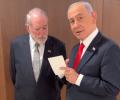
Israeli Prime Minister Benjamin Netanyahu has threatened to continue targeting Iranian leaders, claiming recent successes in eliminating key figures. He asserted that Israel, with US support, aims to undermine the Iranian regime and empower the Iranian people.

'To suddenly give the impression of taking a position that is hostile to Iran, or, at least, not friendly to Iran, is not a good thing.'

When missiles fly in this region, they are never just aimed at military targets.

Israel has for more than two decades and several US presidencies worked to draw the United States into a full-scale war with Iran. Having finally achieved that, the last thing it wants is Trump declaring victory and going home, as he is prone to do. Ali Larijani was the figure most capable of handing Trump a negotiated exit with something to show for it. Without Larijani, the road to an exit gets considerably narrower. Prem Panicker continues his must read daily blog on the Gulf War.

24 Indian-flagged vessels with 677 Indian seafarers were currently located west of the Strait of Hormuz, and four vessels with 101 Indian seafarers were stationed east of the strategic waterway.

Karex, the Malaysian company that makes roughly one in five of the world's condoms -- about five billion a year, supplying Durex and Trojan among others -- announced this week that it is raising prices by up to 30 percent. The reason is the Strait of Hormuz.

Both sides have now revealed a preference for escalation over strategic defeat, and each new provocation narrows the space for the next pause. The Touska seizure, Iran's refusal to negotiate under blockade, Israel's strikes on Iranian oil infrastructure -- all of these add up to an increasingly untenable situation. This makes the wild card -- Trump and his motormouth -- more consequential than ever, notes Prem Panicker in his must read blog on the Iran War.
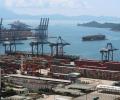
With the Iran war escalating sharply and crisis deepening in the global energy market, India on Monday unveiled a coordinated plan to support exporters and shippers caught in the fallout.

Taking Kharg would give the US control over virtually all of Iran's oil exports and thus provide significant leverage, notes Prem Panicker in his must read daily blog on the Gulf War. It would also put American troops within range of Iran's remaining missiles, drones, and artillery on a piece of real estate that is just eight square miles in size, and just 15 miles from the Iranian mainland.

Will rising tensions between US-Israel and Iran threaten crude oil supply through the Strait of Hormuz, putting India's fuel prices, imports, and economic stability at risk?

By all available indications, the White House drafted a face-saving note and handed it, ready-made, to Islamabad. Pakistani Prime Minister Shehbaz Sharif was supposed to then post it in the guise of a plea urging Trump to extend the deadline by two weeks 'to allow diplomacy to run its course'. Trump would then graciously accept Pakistan's 'request' and declare a ceasefire. Sharif dutifully posted the message on X. Except that he, or whoever was handling the account, forgot to delete the tell-tale first line visible in the edit history: 'Draft - Pakistan's PM Message on X'. Prem Panicker's must read blog on the Iran War.

Iran is fighting a different war: Older, slower, and in some ways more dangerous. Iran doesn't need to shoot down an F/A-18. It only needs to make the Strait of Hormuz feel dangerous long enough for insurance markets, shipping companies, and oil futures traders to do the rest. Prem Panicker continues his must-read daily blog on the war in the Middle East.

The delegations from the US and Iran head to Islamabad on Friday, carrying a ceasefire that is already fraying, a Strait that is technically open and practically closed, and a negotiating agenda that would challenge even parties actually negotiating in good faith, which these groups are not. Prem Panicker continues his must read blog on the Iran War.

Khamenei said the people had chosen who they wanted as president and that 'the Islamic establishment will never manipulate people's votes and commit treason'.

The statement by IRGC which was televised on the country's state media, came, three days after Haniyeh was killed at his accommodation in northern Tehran following his attendance at the inaugural ceremony of Iran's new president Masoud Pezeshkian.

Iranian supreme leader Ayatollah Khamenei on Thursday berated the UN Security Council as a "flagrant form of dictatorship" while terming the US and its Western allies as "bullies" trying to monopolise nuclear fuel production, as he asserted Tehran's right to use atomic energy for peaceful purposes.

Fight on toward goals that keep receding, or exit with most objectives unmet. Trump is agitated, his poll numbers falling below the Plimsoll line, his base fractured between those who back the war and those who remember that he campaigned on ending them.
Weeks before the disputed Iranian presidential polls, US President Barack Obama had sent a direct message to Iran's supreme leader Ayatollah Ali Khamenei seeking "dialogue and engagement" between the two estranged nations.

What we are watching is something different: A fog manufactured and maintained by the people who started the war, so that the question of why it was started never has to be answered, observes Prem Panicker in his must read blog on the war in the Middle East.
